

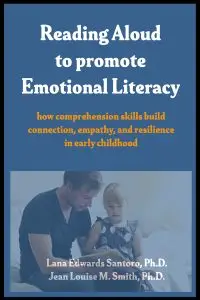
(cover design pending publication)
Reading Aloud to Promote Emotional Literacy
How comprehension skills build connection, empathy, and resilience in early childhood.
Our book is the first to present emotional literacy development through the lens of read alouds for children in preschool through third grade.
Our book takes a novel conceptual approach to apply evidence-based literacy instruction to social-emotional learning in early childhood. Through shared reading and text-based conversations, read alouds build connection and support the development of emotional literacy. Our book is the first to present emotional literacy development through the lens of read alouds for children in preschool through third grade.
Read Alouds are far more than providing students an opportunity to listen to a good story. For students, the power of read alouds represents the integration of language, cognitive, and emotional processing that aligns with basic literacy competencies. Specifically, the literacy skills of comprehension taught during read alouds are the same skills necessary to recognize, understand and respond to emotions. Our book discusses the science of read alouds and how read alouds address the specific comprehension skills required to develop emotional literacy, including: understanding and using vocabulary (emotional vocabulary), identifying main idea and details (emotional granularity), making connections and perspective taking (empathy and compassion), supporting self-monitoring (self-regulation).
Our book will help you:
- Identify how the literacy skills of comprehension taught during read alouds are the same skills necessary to recognize, understand and respond to emotions.
- Identify the key instructional design components of explicit read aloud instruction.
- Use read aloud conversational routines to promote emotional literacy and comprehension skills.
- Help your students be the authors of their own story.
Table of Contents
Chapter 1 – Emotional Literacy
Chapter 2 – Interactive Read Alouds
Chapter 3 – Building an Emotional Vocabulary
Chapter 4 – Getting the Gist and Making Distinctions (Emotional Granularity)
Chapter 5 – Making and Applying Connections (Empathy and Compassion)
Chapter 6 – Self-Monitoring (Self-Regulation and Insight)
Chapter 7 – Pulling it All Together: Applying the Interactive Read Aloud to Storybooks and Information Books
About the Authors
Lana Edwards Santoro, Ph.D., is a Research Professor with the Wheelock College of Education and Human Development at Boston University. She helps direct National Center efforts, including the National Center on Improving Literacy and Lead for Literacy Center, to increase access to, and use of, evidence-based approaches to screen, identify, and teach students with literacy-related disabilities, including dyslexia. Lana also led a series of Institute of Education Sciences studies focused on the use of read alouds and classroom discourse to improve the vocabulary and comprehension of students at-risk of reading failure. She has presented extensively on how to apply evidence-based, instructional strategies in the classroom, and has co-authored multiple reading programs for elementary grade students who struggle with reading, including Pearson’s Early Reading Intervention and Moving-up Literacy’s Enhanced Core Reading Instruction (ECRI) and Read Aloud!: Developing Narrative and Scientific Literacy. Central to Lana’s work is the application of explicit and systematic “comprehension conversations” to literacy development, including literacy in reading and writing, emotional literacy, and the literacy of pain management. Interested in the intersection of education, psychology, and mental health, Lana has taught in residential treatment and psychiatric settings with children and adults experiencing medically complex challenges and disabilities. Throughout her childhood and career as an educator, read alouds have always bookmarked her life.
Jean Louise M. Smith, Ph.D., is an Early Childhood School Psychologist for children birth to five years old receiving early intervention and early childhood special education services in Lane County, Oregon, and a Clinical Assistant Professor at the University of Oregon. She is a graduate of the School Psychology doctoral (2005) and Special Education master’s (2003) programs at the University of Oregon. She has served as a co-principal investigator on an Institute of Education Sciences efficacy study evaluating a multi-tiered system of instructional support in first grade reading and has led the implementation of several research projects. Jean Louise has publications in peer-reviewed journals and is a co-author of a reading curriculum along with Lana. Her professional interests emphasize prevention and early intervention of academic and behavioral difficulties within a systems approach. She enjoys being in preschool classrooms for story times and talking with parents and teachers about evidence-based emotional literacy support in early childhood. Her experience allows her to “connect the dots” of early literacy, social and emotional learning, and early childhood. Jean Louise has fond memories of being read to as a little girl, especially the Berenstain Bears and Amelia Bedelia books. She has enjoyed sharing her love of read alouds with her own children.
Be the first to know!
Give us your contact information and we will let you know when the book publishes.